Winter school holidays in Chiltern: small adventures for cold days
The first morning of the school holidays is always the longest. The lunchboxes go back in the cupboard, the alarms go quiet, and somewhere around half past nine a child arrives at your elbow to announce that there is nothing to do. In a city that is a problem to be solved with bookings and queues. In Chiltern, in winter, it is the start of the good part, because a small town in the cold asks very little of you, and gives a child a great deal of room to find their own day.
Chiltern is not a holiday town in the way the coast is. There is no pier, no big wheel, nothing that runs on tokens. What it has is a wide quiet main street, a national park at the edge of the houses, a lake with ducks and a bridge, and the kind of cold, bright winter days that send everyone home with red ears and an appetite. For a family with a few days to fill, that turns out to be plenty. Here is how the cold weeks go.
On a clear day, go looking for birds
Chiltern is, quietly, one of the best places to watch birds in the state. The box-ironbark forest of the Chiltern–Mt Pilot National Park starts where the town ends, and on a still winter morning it fills with small busy birds working low through the bare branches: robins, treecreepers, honeyeaters, the lot. You do not need to be a birdwatcher to enjoy it with children. You need a pair of basic binoculars, a printed picture or two to match against, and the patience to stand still for ninety seconds, which children can manage far better than adults give them credit for.
Lake Anderson
Ducks, a bridge, and a flat easy lap
The lake sits at the edge of town in the bowl of the old Alliance mine, a bird refuge now with a small heritage bridge over the spillway. It is the easy one: flat, pram-friendly, a slow loop in forty minutes with plenty of stops to throw nothing to the ducks (bring seed, not bread) and watch the water. The best looking is in the last hour of light, when the birds come down to the edge.
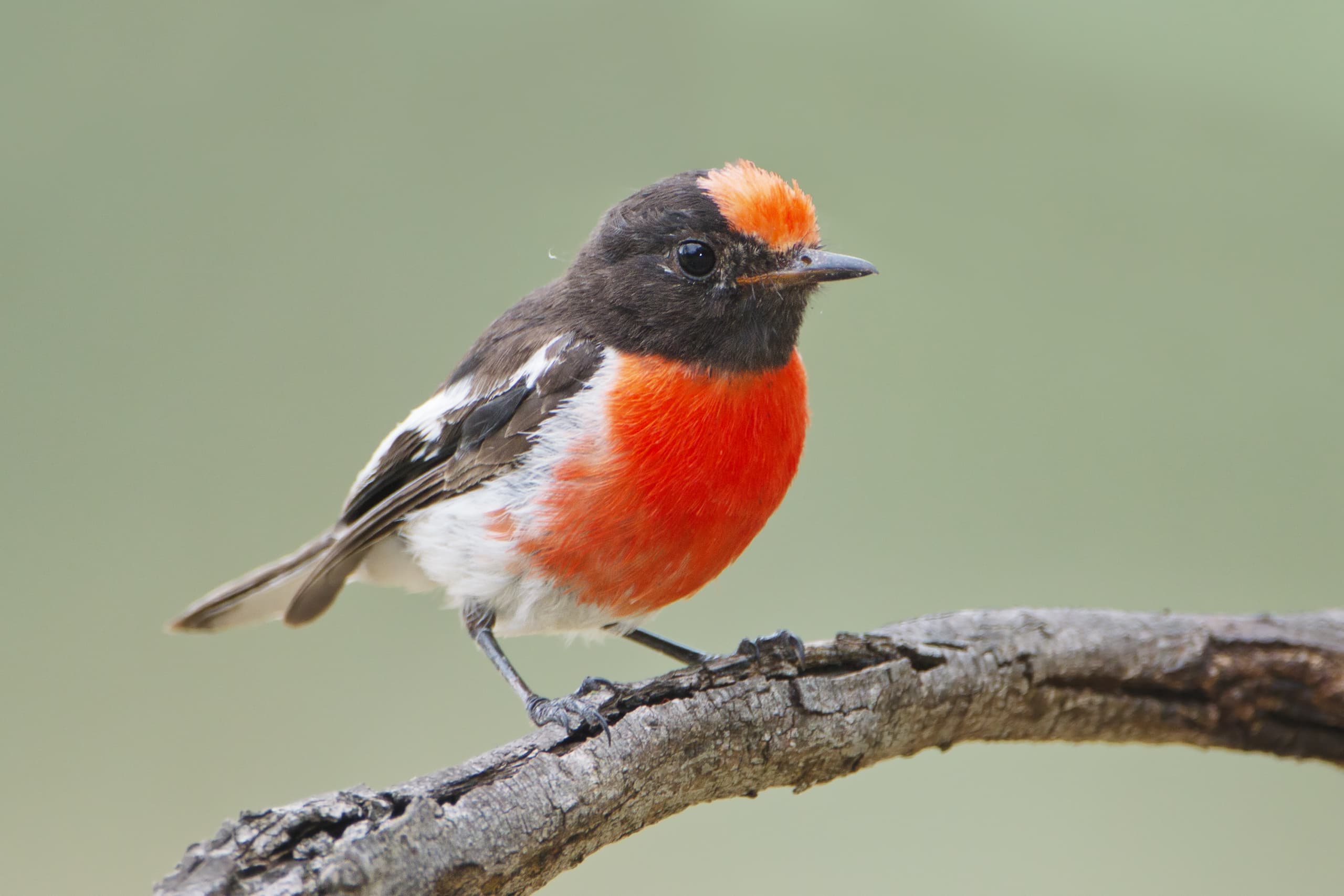
The red-capped robin
The bird to put on the list
If you give the kids one bird to find, make it the male red-capped robin. It is grey and white with a scarlet cap and chest, small enough to fit in a hand, and exactly the sort of flash of colour that makes a child gasp on a grey day. They work the lower branches and fence lines in the park. Finding one is a whole morning's mission, and a good one.
Yeddonba
Rock art at the foot of Mt Pilot
A short, well-made walking track in the south of the park leads to the Yeddonba Aboriginal Cultural Site, where there is rock art, including a faded painting of a thylacine, the Tasmanian tiger, from a time when they still lived on the mainland. Interpretive signs tell the story along the way. For most children it is the most memorable hour of the trip.
Mount Pilot
The granite at the top
For older kids with energy to burn, the lookout walk climbs to a granite summit and a long view over the high country, with Mount Buffalo on the horizon on a clear day. It is a real climb, not a stroll, and the wind at the top is always colder than the forecast. Save it for a bright afternoon and bring more gloves than you think you need.
On a wet day, go indoors and slow down
Not every July day is a clear one. When the rain sets in, Chiltern rewards the family that plans to do less. The Athenaeum Museum, in the old town hall on Conness Street, has two rooms of the town's memory: gold-rush and farming relics, paintings by the local nineteenth-century artist Alfred William Eustace, and a connection to the writer Henry Handel Richardson, who lived here as a child. It is small, warm, and run by volunteers on winter hours, so ring ahead before you go. An hour there on a wet morning is an hour well spent.
After that, the best wet-day plan is the oldest one: get home, get warm, and bake something together. A holiday is a rare stretch of unhurried mornings, and a wet one is made for flour on the bench and a child standing on a chair to reach it. Scones are the place to start: few ingredients, fast in the oven, and forgiving of small hands. If the dough comes out tough, you have learned the first rule of scones, which is not to overwork it. Try again tomorrow; you have the days.
- Scones, the classic wet-morning bake, ready before anyone loses interest
- A pile of library books and the warmest corner of the house
- A jigsaw left out on a side table to drift back to all week
- Hot chocolate after the bird walk, earned and non-negotiable
One morning, come to the bakery
At some point in the fortnight, walk down to the bakery at 27 Conness Street on the western side of the street. The bread is out by seven, and the smell of it reaches the footpath before you do. Children who will not look twice at a sandwich at home will happily eat the heel off a fresh loaf in the cold, and a small bakery has something a child remembers longer than a queue at a theme park: the trays, the warmth, the people behind the bench who have time to say hello in winter. Come early; the plain white and the wholegrain go first.
What to pack for a child in a Chiltern winter
The mornings here sit in the low single digits. Three degrees at dawn is ordinary, and they climb only to the low teens by afternoon, sun permitting. The trick with children is layers they can shed into a daypack as the day warms, and dry feet, which decide the mood of an entire outing.
- A warm waterproof jacket each, plus a spare pair of socks per child
- Beanies and gloves, plus one set in reserve, because one always goes missing
- Gumboots or shoes with a tread; the park tracks stay wet right through July
- Basic binoculars and a printed page of birds to spot
- A daypack with room for shed layers, a flask, and a loaf for later
The holidays will end the way they always do, in a scramble for lunchboxes and the hunt for a missing shoe. But somewhere in the middle of them there is usually one cold, bright, unremarkable day that the children keep: a robin found, a bridge crossed, warm bread eaten in the street with their gloves off. You cannot book that day. You can only leave enough room for it. Chiltern, in winter, is mostly room. Come and fill a few days of it, slowly, and leave with bread.
Thank you for reading.
More from the Journal

Tomatoes by Cup Day: Spring Planting Around Chiltern
Plenty of Victorian gardeners still wait for Melbourne Cup Day to plant their tomatoes. Around Chiltern the reason is frost, and the rule bends a little.
Read
Lake Anderson, the Gold Mine That Became Chiltern's Lake
Nobody dug Lake Anderson as a lake. It is what was left when the ground over an old gold mine sank, and the town has made good use of it since.
Read
Orchid Season in Chiltern's Ironbark Forest
For a few weeks each spring the forest floor outside town does something the rest of the year gives no warning of, and most of it is orchids.
Read